Papua
Papua is Indonesia's most remote and least-developed major region — the western half of the island of New Guinea, home to rainforest, highland tribal cultures, and a level of biodiversity that draws serious naturalists as much as general travelers.
The Baliem Valley, in the highlands, is home to the Dani people and a traditional way of life that remained largely isolated from the outside world until the mid-20th century; visits here typically go through local guides and involve genuine cultural immersion rather than a staged show. The region also holds some of the most linguistically diverse territory on Earth, with hundreds of distinct languages across a relatively small population.
Raja Ampat, off Papua's western tip, is internationally recognized as having some of the richest marine biodiversity anywhere in the world and is treated as its own major sub-destination (see its dedicated page) rather than a simple add-on to a Papua trip.
This is not a casual add-on to an Indonesia itinerary — infrastructure is limited, costs are higher than the rest of the country due to remoteness, and most trips benefit from a specialist local operator rather than independent travel. Dry season and calm-water windows vary significantly by specific area.
Biak is best known for its role in the Pacific campaign of World War II — the 1944 Battle of Biak was a brutal fight for control of the island's airstrips, and remnants are still visible today, most strikingly at Goa Binsari (Japanese Cave), a cave system where hundreds of Japanese soldiers died and where rusted weapons and equipment remain embedded in the rock. Wrecked aircraft and bunkers are scattered elsewhere on the island for those interested in tracking them down. Beyond the war history, Biak has decent beaches and snorkeling, notably around Bosnik and the Padaido Islands just offshore, which see far fewer visitors than Raja Ampat despite comparable reef quality in parts. The island also functions as a transit hub for onward travel into other parts of northern Papua, and its airport was historically significant as a refueling stop on trans-Pacific routes.
Fakfak sits on the southwestern arm of the Papuan peninsula and is one of Indonesia's oldest nutmeg-producing areas, predating the plantation-driven history of Banda in some accounts, with its own distinct cultivar. The town has a mixed Muslim-Papuan cultural identity unusual for this part of Papua, reflecting centuries of trade contact with Maluku and beyond, and it's often cited as one of the more religiously tolerant, mixed-population towns in Papua. Outside of the nutmeg trade, Fakfak is a jumping-off point for the wilder, far less visited coastline south toward Kaimana, though infrastructure for independent travel is minimal — this is a place for travelers comfortable arranging things locally rather than booking packaged tours in advance.
Jayapura is the provincial capital of Papua and its largest city, sprawled around a harbor with steep hills behind it, and functions primarily as an administrative and commercial hub rather than a tourist destination in its own right. Its role in WWII is significant but less visited than Biak's — General MacArthur used it as a headquarters, and wreck and bunker sites exist around the bay for those who seek them out. The more compelling draw is Lake Sentani, a large freshwater lake near the airport ringed by stilt villages where Sentani culture and its distinctive bark-cloth painting tradition survive; the annual Lake Sentani Festival brings traditional dance and canoe processions onto the water itself. Jayapura is also the practical gateway for the PNG land border crossing at Skouw, used by a small but steady stream of overland travelers. Most visitors pass through Jayapura en route to Wamena (flights) or the border, and the city rewards a short stay focused on Lake Sentani rather than an extended stopover in the city center itself, which is a working port town without much built for tourists.
Kaimana is the gateway to Triton Bay, a marine area increasingly recognized by divers as a rival to Raja Ampat for reef health and megafauna, particularly its reliable manta ray cleaning stations and a karst island landscape similar to Raja Ampat's but with a fraction of the boat traffic. It remains far less developed for tourism, meaning access mostly runs through liveaboards or the small number of dive operators based in or visiting Kaimana rather than any land-based resort infrastructure. Outside the water, Kaimana has ancient rock art sites in the limestone cliffs around the bay, painted handprints and figures thought to be thousands of years old, comparable in significance to sites in Raja Ampat and the Bird's Head region. The town itself is small and quiet, functioning mainly as a supply point for the bay's dive operations rather than a destination with its own attractions.
Manokwari holds a notable place in Papuan Christian history as the site where German missionaries first landed in 1855, an event still commemorated locally as a founding moment for the region's Christian communities, marked each February with the Injil Masuk (Gospel Arrival) celebration. The town sits at the base of Table Mountain (Gunung Meja), a forested reserve with old Dutch-era graves and lighthouse remnants that gives Manokwari a green backdrop uncommon among Papua's coastal towns. Manokwari also functions as an administrative capital for West Papua province and a research base for scientists studying the Bird's Head region's exceptional biodiversity. It's not typically a standalone destination but rather a stopover for those working through the region's broader research and conservation circuits, or a base for exploring nearby beaches and the Arfak Mountains further inland, home to distinct highland cultures and birding sites for species like the Vogelkop bowerbird.
Merauke is Indonesia's easternmost city, close enough to the Papua New Guinea border that its lowland savanna ecosystem feels distinctly different from the rest of Indonesia — flat grassland and eucalyptus rather than jungle, home to wallabies, tree kangaroos, and deer more associated with Australia than Southeast Asia. Wasur National Park, just outside town, protects this ecosystem and is the main reason to visit, offering wildlife and birdwatching rare anywhere else in the country. The city itself is a quiet administrative and agricultural center with limited tourist infrastructure, functioning more as a supply town for the surrounding region than a destination with its own sights. Its remoteness — a long flight from anywhere else in Indonesia — means it sees very few foreign visitors outside those specifically drawn by Wasur's ecology.
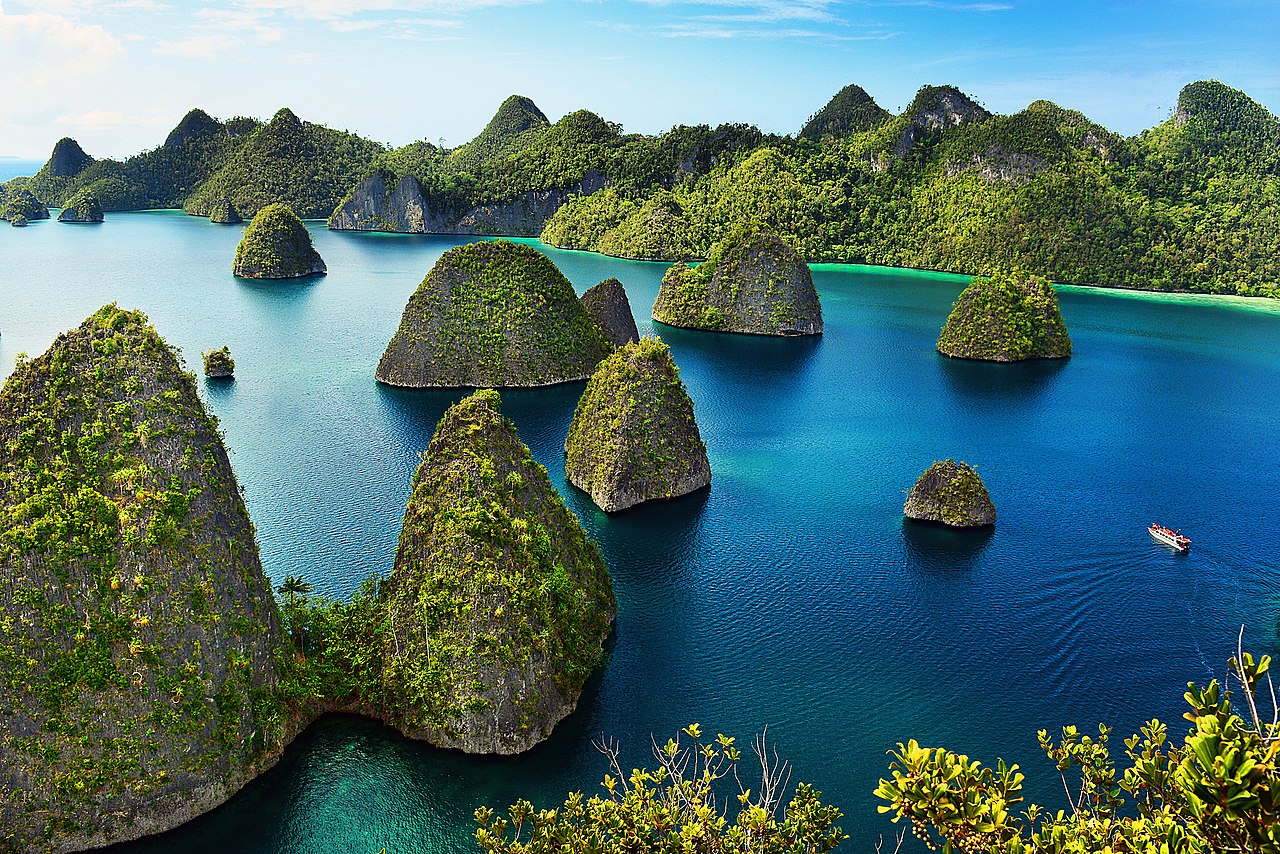
Raja Ampat, off the western tip of Papua, is widely regarded by marine scientists as having the richest coral reef biodiversity on Earth — over 1,500 fish species and 75% of the world's known coral species have been recorded in its waters, a concentration found nowhere else. Above the waterline, the archipelago is just as visually striking: karst limestone islands rising sharply from turquoise water, best seen from above at viewpoints like Piaynemo, which has become one of Indonesia's most recognizable images despite the difficulty of actually getting there. Most visits center on diving or snorkeling, either from a land-based homestay/resort or a multi-day liveaboard boat that moves between dive sites — the latter is the more common way serious divers experience the region's full range, since many of the best sites are hours apart by boat. This is a genuinely remote, high-cost destination relative to the rest of Indonesia, reflecting both the logistics of reaching it and a deliberate local conservation fee structure aimed at limiting overtourism to protect the reefs. October-April is generally considered the better window for calmer seas and visibility, though conditions vary by specific site.
Sorong is almost universally treated as a transit point rather than a destination — nearly everyone passing through is on their way to or from Raja Ampat, and the city's infrastructure (airport, harbor, hotels) is built around that flow. It's a working port and administrative city with little in the way of sights, though it has decent seafood restaurants and is a reasonable place to stock up on supplies or cash before heading into Raja Ampat's more limited services. Most travelers spend a single night here at most, timed around flight and ferry schedules, and there's little incentive to linger longer unless connections force it.
Timika exists largely because of the Grasberg mine, one of the world's largest gold and copper mines, operated nearby in the highlands by Freeport-McMoRan and PT Freeport Indonesia; the town grew rapidly around mine-related jobs, logistics, and services rather than any pre-existing settlement or tourism draw. For travelers, it functions almost exclusively as a transit point — a stopover for those connecting to remote parts of the central highlands or dealing with mine-related business — rather than a destination in itself. There's little to see in Timika beyond its function as a logistics hub, and most visitors pass through only as long as flight connections require.
Wamena is the gateway to the Baliem Valley, a highland region that stayed unknown to the outside world until a 1938 aerial expedition spotted it, and whose Dani, Lani, and Yali communities maintained a stone-age-adjacent way of life — including the use of the koteka (penis gourd) as traditional dress for men in some communities — well into the 20th century, and to a limited, largely ceremonial extent still today. That isolation, enforced by the surrounding mountains rather than choice, is why the valley remains one of the most culturally distinct places to visit in Indonesia, and also why it demands more logistical effort than almost anywhere else in the archipelago: no roads reach it, everything arrives by air, and trekking beyond Wamena town means multi-day hikes with porters and guides. The annual Baliem Valley Festival is the most accessible way to see the region's ceremonial culture concentrated into one event, featuring mock tribal battles, traditional dress, and pig feasts that draw participants from villages across the valley. Outside festival dates, travelers typically arrange multi-day treks to visit villages, see traditional Dani salt-making at Pugima or smoked mummies preserved by some communities as ancestor relics, and experience the valley's dramatic mountain scenery. Wamena town itself is basic and functional — a market center for the valley's sweet-potato-based agricultural economy — and most of what draws visitors lies in the surrounding villages and trekking routes rather than the town. Papua's ongoing low-level separatist tension has occasionally affected the region, including periods of restricted access or safety advisories, so checking current conditions before committing to a Baliem trip is essential, more so than for most other Indonesian destinations. Given the flight-only access, weather-dependent schedules, and need for trekking guides, Wamena is not a place to visit on a tight itinerary — build in slack for delays and plan at least four days to make the logistics worthwhile.
Papua FAQs
Most tourist areas (Raja Ampat, the Baliem Valley with a local guide) are visited safely every year, though some interior regions have periodic unrest — check current advisories for the specific area before planning.
Strongly recommended, especially for highland cultural visits and remote trekking — infrastructure is limited and local guides provide both logistics and respectful cultural access.
Geographically part of Papua province, but treated as its own major destination given its distinct focus (diving) versus the highlands' cultural trekking.
10 days or more, given the remoteness and travel time between the highlands and coastal areas.
Remoteness drives up costs — limited flights, higher fuel and goods prices, and a reliance on specialist local operators rather than budget independent travel.
Things to do in Papua




Reviews/Comments
No comments yet — be the first.