Palembang
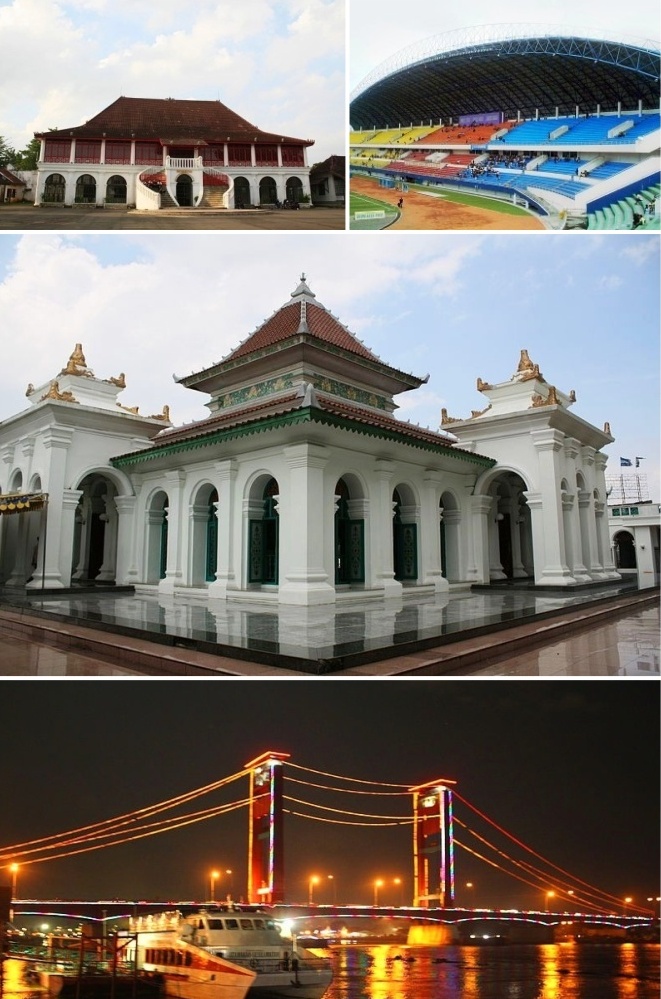
Palembang claims to be the historical seat of Srivijaya, the powerful maritime trading empire that dominated the Malacca Strait and much of maritime Southeast Asia from roughly the 7th to 13th centuries — a claim supported by archaeological finds along the Musi River, though the exact location of Srivijaya's capital remains debated among historians, with Muaro Jambi in neighboring Jambi province also a strong contender. Palembang leans into this legacy regardless, and the Musi River itself, spanned dramatically by the Ampera Bridge, remains the organizing feature of the city, much as it likely was in Srivijaya's era.
Kemaro Island, a small island in the middle of the Musi River, holds a Buddhist-Chinese temple and pagoda tied to a well-known local legend of a Chinese prince and a local princess, and is a popular boat destination especially lively during Chinese New Year celebrations, reflecting Palembang's significant Chinese-Indonesian population and history as a trading port. The Great Mosque (Masjid Agung), built by the Palembang Sultanate in the 18th century, blends Javanese, Chinese, and European architectural elements in a way distinctive to the city's layered trading history.
Palembang is also the origin of pempek, a fishcake dish served in vinegar-based sauce that's exported across Indonesia but best and most varied in its home city, along with other river-adjacent specialties reflecting the Musi's role as both trade route and food source. Two days is a reasonable amount of time to explore the riverfront, visit Kemaro Island by boat, see the Great Mosque, and eat through the city's pempek variations without needing to extend further.
Palembang FAQs
It's the leading traditional claim, supported by archaeological finds along the Musi River, though historians also point to Muaro Jambi in neighboring Jambi province as a strong alternative candidate — the exact location remains genuinely debated.
By boat from Palembang's riverfront, either a shared ferry or a chartered kapal ketek; trips are short and easy to arrange on the spot, with no advance booking needed outside of Chinese New Year when it gets significantly busier.
Seek out dedicated pempek stalls and small restaurants rather than general food courts — the dish comes in several distinct varieties (kapal selam, lenjer, adaan) worth trying side by side, and Palembang's versions are considered the benchmark against the dish's export elsewhere in Indonesia.
Yes, river travel is a normal and enjoyable part of getting around central Palembang, with boats ranging from basic public ferries to more comfortable chartered options for sightseeing.
Yes, generally — the city's core sights (Musi riverfront, Kemaro Island, the Great Mosque, and its food scene) fit comfortably into two days without feeling rushed.
More in Sumatra




Reviews/Comments
No comments yet — be the first.