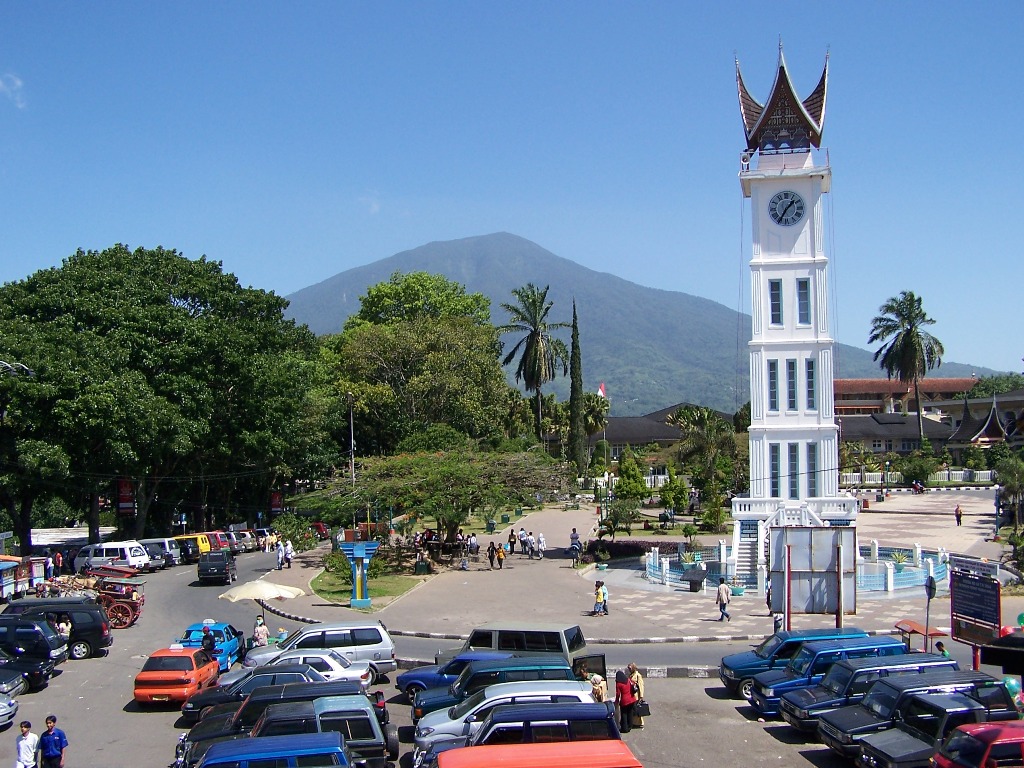
Bukittinggi
Bukittinggi is the cultural heart of the Minangkabau people, the world's largest matrilineal society, in which property and family lineage pass through the female line even as public and religious life remains led by men — a structure locals will explain readily and that shapes noticeably different gender dynamics from most of Indonesia. The town's Jam Gadang clock tower, a Dutch colonial-era landmark with a distinctive Minangkabau-style roof added later, anchors a lively central market area selling regional textiles, food, and crafts.
Minangkabau architecture is instantly recognizable for its dramatic curved, upward-sweeping roof gables (gonjong), said to evoke buffalo horns, best seen in traditional rumah gadang longhouses in surrounding villages and reconstructed at the Pagaruyung Palace replica near Batusangkar, a short drive away. The Ngarai Sianok canyon, a steep, jungle-filled gorge right on the edge of town, and nearby Japanese-built WWII tunnels (Lubang Jepang, dug using forced Indonesian labor) add both scenic and difficult-history dimensions within easy walking distance of the center.
Bukittinggi is also a launching point for the Harau Valley, a striking canyon of sheer cliffs and rice paddies, and Lake Maninjau, a large volcanic caldera lake with a dramatic switchback road descent, both reasonable day trips. Minangkabau cuisine, most famously rendang, originates from this region, and Bukittinggi's restaurants are a legitimate, arguably better, place to eat it than the diaspora Padang restaurants found across Indonesia and the world that take their name from the neighboring city.
Three days allows for the town itself, a day trip to either Harau Valley or Lake Maninjau, and time to explore the matrilineal culture and cuisine that make this region distinct within Sumatra.
Bukittinggi FAQs
Property and family names pass through the female line, and you'll see this reflected in traditional rumah gadang house structures and local explanations of family life, even though public and religious leadership remains predominantly male — it's a genuinely distinctive social structure worth asking a local guide about directly.
Bukittinggi, arguably — the cuisine is regional to the Minangkabau highlands broadly, and Bukittinggi's restaurants serve it in its home context, whereas the globally familiar 'Padang restaurant' format is more of a diaspora export style.
By car or shared minivan from Padang, about 2-2.5 hours, since Bukittinggi has no airport; most travelers fly into Padang first.
Lubang Jepang, a tunnel network dug during the Japanese occupation using forced Indonesian labor (romusha), now open for guided walk-throughs a short distance from the canyon rim.
Harau Valley offers dramatic sheer cliffs and rice-paddy scenery in a compact area, while Lake Maninjau is a larger volcanic caldera lake with a scenic but longer drive — Harau suits a shorter day, Maninjau rewards a slightly longer one.
More in Sumatra


Reviews/Comments
No comments yet — be the first.