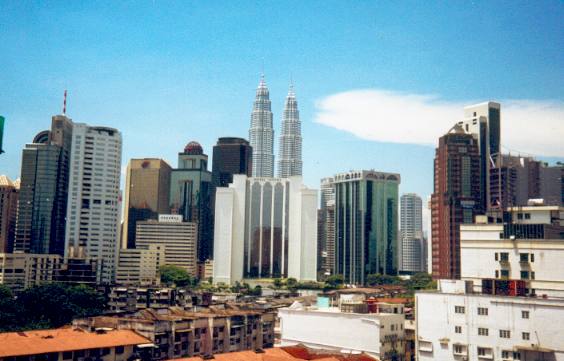
Kuala Lumpur
Kuala Lumpur is a genuinely multicultural capital where Malay, Chinese, Indian, and indigenous influences sit side by side rather than blended into something homogeneous - you can walk from the colonial-era Merdeka Square and the Masjid Jamek mosque into Chinatown's Petaling Street, then into Little India's Brickfields, all within a few kilometers of the glass-and-steel Petronas Towers. That juxtaposition, old shophouses under the shadow of one of the world's tallest twin towers, is the city's defining visual.
The food is arguably KL's strongest card: hawker centers and mamak stalls (24-hour Indian-Muslim eateries) serve some of the best and cheapest food in Southeast Asia, and it's worth structuring at least one day purely around eating - nasi lemak, banana leaf rice, char kway teow, and late-night roti canai are all genuinely excellent here rather than tourist-adjacent versions of themselves. The Petronas Towers and KLCC Park are the postcard image, but the Batu Caves just outside the city (a Hindu shrine built into limestone caverns, reached by a steep flight of rainbow-painted stairs guarded by macaques) is arguably more memorable and shouldn't be skipped as a half-day trip.
KL can feel disjointed to first-time visitors because it lacks a single compact 'old town' the way Malacca or Penang do - the city grew as a tin-mining boomtown and later a modern capital, so its history is scattered across neighborhoods rather than concentrated in one walkable core. Bukit Bintang is the modern retail and nightlife hub, Chinatown and Merdeka Square hold the colonial and early-20th-century history, and KLCC is the 21st-century financial and shopping district; treat KL as three or four distinct areas connected by rail rather than one city center you can cover on foot.
Traffic and heat are the two things that will shape your days here more than anything else - the tropical humidity makes outdoor walking between sights tiring by midday, and KL's roads were built for cars, not pedestrians, with highways and flyovers cutting through areas that look close together on a map but are awkward to cross. Plan around the rail lines, do outdoor sightseeing (Batu Caves, KLCC Park) in the morning, and save the malls and hawker centers for the heat of the afternoon and the cool of the evening.
Batu Caves is a limestone hill riddled with cave temples, most famously reached by climbing 272 brightly painted steps up to the main Temple Cave, guarded at the base by a towering gold statue of Lord Murugan — one of the tallest statues of a Hindu deity anywhere. Inside, the cave opens into a large natural chamber with shrines lit by openings in the rock ceiling above. The site is a major pilgrimage destination, especially during the Thaipusam festival when huge crowds and elaborate processions fill the complex, but on an ordinary day it's a straightforward and rewarding half-day trip from KL. Long-tailed macaques are common around the steps and can be bold around food, so keep bags closed.
KL Tower offers panoramic views over Kuala Lumpur from an observation deck and open-air Sky Deck, with the added novelty of the Petronas Towers visible in the skyline rather than being the view itself — a useful vantage point precisely because it includes the twin towers rather than being them. It sits on a forest reserve hill, giving it a slight elevation advantage even before factoring in the tower's own height. Compared to the Petronas Towers' skybridge and observation deck, KL Tower tends to be less crowded and often cheaper, and its Sky Deck option (open-air, higher up) offers a different, more exposed viewing experience for those wanting it.
Petronas Twin Towers: The Petronas Towers were the tallest buildings in the world when completed in 1998 and remain the tallest twin towers globally, an instantly recognizable steel-and-glass silhouette that anchors KL's skyline. Visits include the double-decker Skybridge connecting the towers at around the 41st-42nd floor, followed by an observation deck near the top of Tower Two for city views. Tickets are timed and limited per day, so booking online in advance is strongly recommended, especially for popular sunset slots, since walk-up tickets can sell out entirely on busy days. The base of the towers opens onto Suria KLCC mall and KLCC Park, making it easy to combine the visit with shopping or an evening at the park's fountain show.
Kuala Lumpur FAQs
Three days covers the main areas well - KLCC/Petronas Towers, Chinatown and Merdeka Square, Bukit Bintang, and a half-day trip out to Batu Caves - though the city rewards more time if food is a priority.
Yes, strongly recommended - the skybridge and observation deck sell timed tickets that sell out days ahead, especially early morning and sunset slots.
It covers the main tourist corridor reasonably well (LRT, MRT, monorail), but different lines are run by different operators with imperfect transfers, so most visitors mix rail with Grab rather than relying on one exclusively.
Yes, it's one of the most memorable sights near KL - a Hindu shrine built into limestone caverns reached by a steep rainbow-painted staircase, and it works well as a half-day trip.
Bukit Bintang is the most convenient for first-timers, close to rail lines, shopping, and nightlife, with Chinatown a short ride away for heritage sights and cheaper food.
Things to do in Kuala Lumpur


Reviews/Comments
No comments yet — be the first.